|
The Grenoside Sword Dance
is one of the very few ritual dances of The Grenoside Sword
Dance
can be traced back to the 1750s but prior to that no one knows. The
first
written mention of the dance was in a Pall Mall Gazette article of
1895. At the
same time Lady Tweedsmuir (an important writer in her own name and also
the
wife of John Buchan of The Thirtynine Steps
fame) wrote in her memoirs The Lilac and
the Rose of seeing the sword dancers perform at Wortley Hall. She
compared
the gentility of her surroundings with the historical, rough and
elemental
nature of the dancers and their dance.
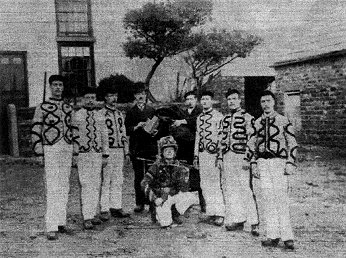
The photograph below is
contemporary with the 1895 writings and was probably taken on one of
the many
walking tours that the team made. Some of these tours were by request
to
perform at local grand houses for beer and sandwiches but other tours
were for
the enjoyment of the local people.
![]() The Grenoside Sword Team over 100 years ago There were occasions when
a collection of money was taken. One of the stories within the team is
of a
collection at Earl Fitzwilliam’s Christmas party at Wentworth which
realised
the astonishing sum of 25 pounds. It is said that a gleeful and
unrepeatable
expletive rent the air from one of the more pious members of the team! The cash was never the
reason to go dancing but it certainly helped. It must be remembered
that
Christmas was a difficult period for working men and women. In the
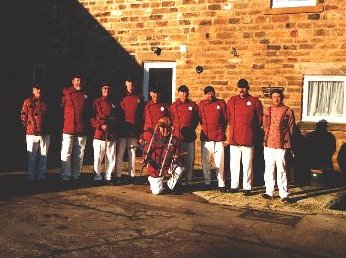
![]() Boxing Day, more than a century on from the first picture above. The glory of the 1951 jackets is highlighted by the low mid-day sun! Other than during the two
World Wars (when Grenosiders had other things to do!) the dance has
been
performed during the Christmas period and particularly on Boxing Day –
a day
close to the Winter Solstice. Boxing Day became the focal point of the
Grenoside Sword Dancers’ year. On Boxing Day at
The Captain sings a song
of bravery and love and the dance proceeds with his symbolic beheading
and
death. The main part of the dance then starts and immediately the
Captain
revives and “rises from the dead” to lead the dancers in reviving the
spirit of
the New Year. The six dancers weave intricate patterns with their
swords and
equally complicated rhythms with their steel-shod clogs. The dance
reaches its
climax as the fiddler increases the tempo of the dance whilst the
dancers
perform a rolling figure. The dancers finally form a tight circle and
perform a
fervent tattoo on the floor before raising their swords, pointing
upwards to
the sky and, one hopes, a mid-winter sun. Each year a large audience
of locals and visitors from far afield come to witness the dance and
celebrate
the renewal of friendships and a new year. After
the dancing is done you may be lucky enough
to hear traditional Grenoside carols being sung in a local pub. You may
ask,
“what are traditional Grenoside carols?” Well
that will have to wait for another time
or better still get yourself up to Grenoside on Boxing day and become
part of
the tradition. |
|
The Grenoside Sword Team two centuries on from the first picture (taken during the 2001 Village ‘Traipse’) |
| The Grenoside Sword Dance The text of a publicity pamphlet written by the much-missed Peter Clarke in 1995. This dance belongs in the village of Grenoside on the north-west edge of Sheffield. It still forms an important mid-winter ritual for the village when we dance outside the Old Harrow in Main Street at 11 o'clock on Boxing Day. It has been danced in the village for many years: the earliest printed account was in the Pall Mall Gazette in January 1895, there is a photograph dated 1885 and a written record which probably dates from the mid 1700s. At times it has seemed that the dance may die, but men have always sprung up to learn from the old dancers and to carry on the tradition. Our fiddler's grandfather was in the team and there are still other family connections with the dance. Dancers from before the war still live in the village. The dance continues to evolve: Cecil Sharp's account does not match our present dance precisely and before the last war the stepping was more elaborate and the dance was followed by Ring 0' Roses in which each man stepped a solo. At that time each man's jacket was different and the Captain's helmet was covered by a rabbit (or hare?) skin rather than the fox fur of today. At other times the music has been played on a melodeon instead of a fiddle, but the four tunes (Drops 0' Brandy, Roxborough Castle, Wonder Hornpipe and Smash the Windows) remain the same. The Captain and the six men dance a series of figures which are similar to other long sword traditions and cycle round the six swords in turn. However the sequence and style of the dance, the break step between figures, the songs, the beheading of our captain, the music and the costume make this dance unique. The 'new' swords of Sheffield Steel date from 1933 and the scarlet paisley jackets with green and red braid and rosettes were made for the Festival of Britain in 1951. Our iron shod clogs sound best on good flagstones. We do not dance simply for the pleasure of it, for beer money or a good day out; we dance because this dance, this tradition matters to us. We often speak of 'our' dance but in a sense we belong to it rather than it to us. It may signify much or little, one thing to one dancer and another to another, but it marks the season for all of us with a special sense that we have performed an important rite for ourselves and our witnesses. For some of us and of the bystanders, the Boxing Day dance gives a perceptible shove to the turn of the year and encourages us to believe that winter's dark and cold will again yield to warmth and light before we give up hope - and reminds us that life follows death as death follows life. At other times and places we dance to share the dance with friends and to improve our funds, but the Boxing Day ritual has a meaning of its own. In 1994 we revived the custom of taking the dance around the village later in the Christmas period. We have not toured the 'Big Houses' for miles around over several days as the team used to do but on the Saturday nearest Twelfth Night we dance at shops and pubs and houses where the dance is honoured. These days we may be seen in newer duller jackets because the stature of the dancers has changed over the last forty years, and because we have so far been unable to find material to match the splendour of the 1951 jackets. When we dance indoors on delicate floors we muffle our clogs with rubber. The ceremony has been recorded on film and video, and was studied in depth in the 1980s. |
Click here for this year's Traipse programme
|
Click here for this year's Traipse programme
|
|
|
Boxing
Day 2001 The Captain sings his song in front of a large audience. |
Sheffield & other related
links
| Sheffield.co.uk A site provided
by Sheffield based web designers Webtechnik with links to many community, cultural and business aspects of the city. |
|
| Sheffield Bulletin Board | Sheff Web |
| The City of Sheffield A
site with comprehensive links, provided by the University.
Your webmaster's own family web site (click here) has links to other related (and unrelated) pages. |
|
Visitors since 6/2/03
Compiled by Gerry Bates
© Grenoside Sword Dancers
Updated 6 February 2003.